
ProCell Microchanneling for Hair Loss: Supporting a Healthier Scalp and Stronger Hair Growth

Hair thinning is rarely caused by one factor alone. Genetics, hormones, inflammation, nutrition, stress, medical conditions and the health of the scalp can all influence the way hair grows. This is why the most effective approach is often not a single treatment, but a personalised plan designed around the individual.
ProCell microchanneling is one of the non-surgical options we offer at Hair Again Clinic to support the scalp environment and encourage healthier-looking hair growth. It may be used as a standalone scalp treatment for selected clients or combined with other recommendations as part of a wider hair-restoration programme.
What Is ProCell Microchanneling?
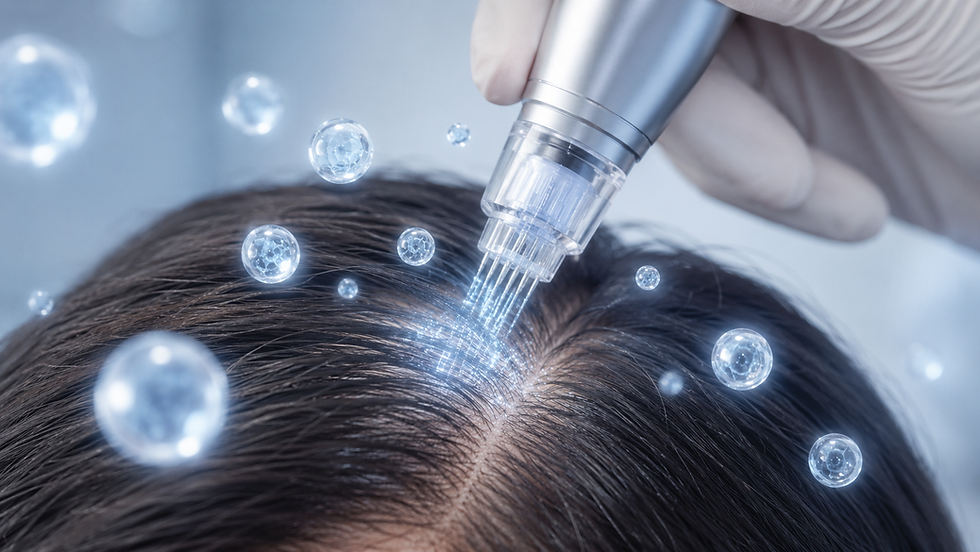
ProCell microchanneling is a professional treatment that uses a precision stamping device fitted with very fine needles. The device creates thousands of controlled microchannels across the treatment area without removing hair or making surgical incisions.
These tiny channels initiate the skin’s natural repair response. They also allow a carefully selected professional serum to be applied directly and evenly across the scalp during the treatment.
The ProCell device works with a vertical stamping action rather than a rolling or dragging motion. This allows the practitioner to work methodically through areas of thinning while maintaining consistent contact with the scalp.
What Is in the ProCell Hair Serum?

The professional serum used during ProCell hair microchanneling contains a specialised blend of human bone-marrow stem-cell-culture-derived cytokines and growth factors. These are signalling proteins associated with the body’s natural communication, repair and renewal processes. The serum does not contain whole or living stem cells.
The ProCell hair formulation is described as containing 12 specific growth factors that target the Wnt cell-signalling pathway, including WNT-1a signalling molecules. The Wnt pathway is involved in hair-follicle development, cycling and the transition between resting and active growth phases.
By applying the serum across the freshly created microchannels, the treatment is designed to deliver these supportive signalling ingredients directly to the treated scalp environment. Their intended role is to support follicle activity and renewal; however, they cannot create new follicles or guarantee hair regrowth.
How Can Microchanneling Support Hair Growth?
Hair follicles are influenced by the tissue, blood supply and signalling environment around them. Microchanneling is intended to create a controlled healing response within the scalp and support the conditions surrounding existing follicles.
Depending on the individual, treatment may help to:
support circulation within the treated scalp tissue
encourage natural repair and cell-signalling activity
improve the delivery of a professional scalp serum
support the environment around existing hair follicles
complement topical hair-loss treatment where clinically appropriate
improve the overall condition and quality of the scalp

Research into microneedling for androgenetic alopecia—commonly known as male or female pattern hair loss—is encouraging. Studies have reported improvements in hair-count and hair-diameter measures, particularly when microneedling is combined with treatments such as topical minoxidil. However, techniques and treatment protocols vary between studies, and more high-quality research is still needed.
For this reason, we describe ProCell microchanneling as a supportive treatment rather than a guaranteed solution. It cannot create new follicles where follicles are no longer present, and it does not remove the hormonal, genetic or medical causes of hair loss.
ProCell Microchanneling Versus Traditional Microneedling
The terms microneedling and microchanneling are sometimes used interchangeably because both treatments use fine needles to create controlled channels in the skin.
The main difference is the way the ProCell device is applied. ProCell uses a vertical stamping action, creating channels with each controlled placement of the treatment head. Traditional devices may use a pen or roller that is moved across the skin.
For scalp work, the stamping technique allows targeted treatment through the hair and across areas of reduced density. The most important factors, however, remain appropriate client selection, sterile technique, correct treatment settings and a plan based on the cause and stage of the hair loss.
Who May Be Suitable for ProCell Microchanneling?
ProCell scalp microchanneling may be considered for men and women experiencing:
early hair thinning
male or female pattern hair loss
gradually reduced density through the hairline, crown or top of the scalp
progressive miniaturisation where viable follicles are still present
reduced scalp quality that may benefit from additional support
age-related changes in hair thickness and density
a preference for a non-surgical, non-blood-based treatment
the need for a complementary treatment within a broader hair-loss programme
It may also be an option for someone who is not ready for—or is not suitable for—a blood-based treatment such as PRP, PRF or GFC. This does not mean the treatments are interchangeable. Each works differently, and the right recommendation depends on the client’s assessment, scalp findings, medical history, goals and budget.
Why an Assessment Comes First
Not every type of hair loss should be treated with microchanneling. Sudden shedding, active scalp disease, infection, scarring alopecia, patchy autoimmune hair loss or hair loss linked to an untreated medical or nutritional issue may require a different approach or medical referral.
At Hair Again, we assess the pattern of loss, the condition of the scalp and whether viable follicles remain in the affected area. We also consider health history, medication, recent stressors, nutrition, hormones and relevant blood results where appropriate.
This allows us to determine whether ProCell microchanneling is suitable and whether it should be used alone or as one part of a more complete treatment plan.
What Happens During a Treatment?
Before treatment begins, the scalp is checked and prepared carefully. The ProCell device is then worked systematically across the selected area using its controlled stamping action. A professional serum is applied as part of the treatment protocol.
Most clients describe the treatment as manageable, although sensitivity varies between individuals and across different areas of the scalp. The appointment length depends on the size of the area being treated.
Immediately afterwards, the scalp may look pink or feel warm, tight or mildly tender. Small pinpoint marks can occur. These effects are generally temporary, but every scalp responds differently.
You will receive aftercare instructions, including when to wash your hair and when to restart active scalp products or prescribed topical medication. It is important to follow the instructions provided to reduce irritation and support uncomplicated healing.
How Many Treatments Are Recommended?
Hair growth is slow, and meaningful change cannot be assessed after only a few days or weeks. We generally recommend a course of treatments rather than a single session, with the exact timing based on scalp response and the wider treatment plan.
For many clients, an initial course of approximately six sessions may be recommended. Progress is documented with consistent clinical photographs and reviewed over time. Maintenance may then be considered depending on the cause of the hair loss, response to treatment and any ongoing home-care or medical programme.
Results vary. Some clients may first notice reduced shedding or an improvement in hair quality, while visible changes in density take longer. As with all hair-loss treatments, no specific amount of regrowth can be guaranteed.
Can ProCell Be Combined With Other Hair-Loss Treatments?
Yes. For suitable clients, microchanneling may sit alongside other forms of hair and scalp support, including:
topical or oral hair-loss medication prescribed by a doctor
professional scalp-support formulations
targeted nutritional support where a need has been identified
LED or other supportive scalp treatments
an individualised home-care programme
The timing of treatments and topical products matters. More is not always better, and combining too many active treatments without a clear protocol can irritate the scalp. Your Hair Again practitioner will explain which options may be appropriate and how they should be spaced.
When ProCell Microchanneling May Not Be Appropriate
Treatment may need to be postponed or avoided if there is an active scalp infection, open or broken skin, a significant inflammatory flare, poor wound healing, certain bleeding concerns, or another health factor that makes needling unsuitable.
Pregnancy, breastfeeding, medication use and existing medical or scalp conditions must be disclosed during consultation. Where necessary, we may request medical clearance or recommend assessment by a GP or dermatologist before proceeding.
ProCell Microchanneling Pricing at Hair Again
Treatments start from $395 per session, depending on the area of the scalp being treated. An initial course of approximately six treatments is commonly recommended, although your plan may differ following assessment.
We will explain the recommended treatment area, number of sessions, full investment and any alternative options before you decide whether to proceed.
Is ProCell Microchanneling Right for You?
ProCell microchanneling can be a valuable option for supporting scalp health and existing hair follicles, particularly when thinning is identified early and the treatment forms part of a considered, consistent plan.
The first step is understanding why your hair is changing. A Hair Again consultation allows us to examine the scalp, assess the pattern and stage of loss, and discuss the treatments most suited to you—whether that includes ProCell microchanneling or a different approach.
Book a hair and scalp consultation with Hair Again Clinic in Auckland to receive a personalised assessment and treatment recommendation.

FREQUENTLY ASKED QUESTIONS.
Is ProCell microchanneling painful? - Most clients find the treatment manageable, although it can feel prickly or sensitive in some areas. Comfort varies between individuals.
Is there downtime after scalp microchanneling? - The scalp may be pink, warm or mildly tender following treatment. Most reactions are temporary, but clients should follow their individual aftercare instructions and avoid applying unapproved products immediately afterwards.
Can ProCell microchanneling regrow hair on a completely bald area? - Microchanneling is designed to support the scalp environment and existing follicles. It cannot create new follicles in areas where follicles are no longer viable, which is why an assessment is essential.
Can I use minoxidil with ProCell treatments? - Microchanneling is sometimes incorporated into plans that include topical minoxidil. However, minoxidil should not be applied immediately after treatment unless specifically directed. We will give you personalised instructions on when to pause and restart it.
How soon will I see results? - Hair grows slowly, so results are assessed over months rather than days. The timing and degree of change vary according to the type and stage of hair loss, follicle viability, general health and consistency with the treatment plan.
Evidence and Further Reading
Ahmed KMA et al. Evaluating the efficacy and safety of combined microneedling therapy versus topical minoxidil in androgenetic alopecia: a systematic review and meta-analysis. Archives of Dermatological Research, 2025. https://pubmed.ncbi.nlm.nih.gov/40056230/
Pei D et al. Efficacy and safety of combined microneedling therapy for androgenetic alopecia: a systematic review and meta-analysis. Journal of Cosmetic Dermatology, 2024. https://pubmed.ncbi.nlm.nih.gov/38239003/
English RS Jr et al. Microneedling and Its Use in Hair Loss Disorders: A Systematic Review. Dermatology and Therapy, 2022. https://link.springer.com/article/10.1007/s13555-021-00653-2
ProCell Therapies. Official device and company information. https://procelltherapies.com/
ProCell Hair Aftercare product information: 12 specific growth factors targeting the Wnt cell-signalling pathway. https://thebeautyparlour.co.nz/products/procell-hair-aftercare-serum
Cashmore Clinic. ProCell conditioned-media and hair-treatment information. https://cashmoreclinic.co.nz/pages/procell
Website disclaimer: This information is general and educational and does not replace medical advice. Suitability, treatment response and results vary between individuals. A consultation is required before treatment, and Hair Again may recommend medical assessment or referral where appropriate.


Comments