
Exosomes for Hair Loss: Do They Really Work
Hair restoration is changing rapidly, and one of the treatments generating the most interest is exosome therapy for hair loss.
But with so much discussion online around stem cells, regenerative medicine and exosomes, it can be difficult to understand what exosomes actually are, how they may support hair growth, and whether they are suitable for everyone.
At Hair Again, we believe new treatments should be approached with both optimism and realism. Exosome-based therapies are showing encouraging potential in hair restoration, but they are not a miracle cure for every form of hair loss.
Here is what we currently know.
What Are Exosomes?
Naturally occurring exosomes are extremely small extracellular vesicles released by cells.
One of their important roles is cell-to-cell communication. They can carry signalling molecules such as proteins, peptides and other biological information between cells, which is why they have become an area of significant interest within regenerative medicine.

Hair follicles rely on complex communication between the cells surrounding the follicle to regulate growth, resting and shedding.
Researchers are therefore investigating whether exosome-related signalling may help support the environment surrounding the hair follicle and encourage healthier follicular activity.
Early research has reported potential effects on pathways associated with follicular regeneration, dermal papilla cell activity, inflammation and the hair growth cycle. However, clinical research in humans is still developing and larger controlled studies are needed.
Can Exosomes Help Hair Grow?
This is where the research becomes particularly interesting. Recent clinical reviews have reported improvements in measures such as hair density and hair shaft thickness following various exosome-based treatments.
A 2025 systematic review examining clinical evidence across different types of alopecia identified 11 clinical studies. Improvements were reported in at least one hair-growth parameter across the included studies, although the researchers also highlighted considerable differences between the products, treatment methods, study designs and follow-up periods.
A further 2026 systematic review found similarly encouraging early results but concluded that larger randomised controlled trials, greater manufacturing standardisation and longer-term research are still required.
So the answer is:
Exosome-based treatments appear promising, but we are still learning exactly where they fit within long-term hair-loss management.
For this reason, at Hair Again we prefer to discuss exosomes as part of a broader hair restoration strategy, rather than presenting them as a stand-alone cure.
How Could Exosome Treatments Support the Hair Follicle?
The potential benefits currently being investigated include:
supporting communication between cells surrounding the hair follicle
encouraging dermal papilla cell activity
supporting the follicular environment
promoting scalp health
supporting microcirculation and nutrient delivery
helping support follicles during the active growth phase
potentially assisting with hair density and shaft quality.
Importantly, an exosome treatment cannot remove every underlying cause of hair loss. For example, if someone has androgenetic alopecia driven by genetics and DHT sensitivity, addressing the follicular environment alone does not necessarily address the hormonal driver.
Similarly, hair thinning associated with low iron stores, thyroid disorders, hormonal changes, nutritional deficiencies, medication, illness or significant stress may require those underlying factors to be investigated as well. That is why understanding the cause of the hair loss comes first.
Natural Exosomes vs Synthetic Exosome Technology
This is an important distinction because the word “exosome” is now being used to describe a wide variety of products.
Naturally derived exosomes may originate from biological cell sources, including different types of mesenchymal stem cells.
There are also synthetic or non-biological exosome-inspired technologies designed to replicate some of the signalling or regenerative concepts associated with natural exosomes without using human or animal-derived cellular material.
One professional system used within this field is INNO-EXOMA® EXO-SKIN from INNOAESTHETICS.
INNOAESTHETICS describes EXO-SKIN as a high-concentration, non-biological exosome-inspired complex developed using its NARBEX™ technology.
Its formulation contains an amino acid complex, peptide complex and hyaluronic acid and has been developed for professional use on skin and concerns including hair that appears thinner or less voluminous.
For clients, this distinction is important.
Not every treatment marketed as an “exosome treatment” contains the same ingredients, comes from the same source or works in exactly the same way.
How Is Exosome Treatment Performed on the Scalp?
Delivery method is another important consideration.
Depending on the treatment and product being used, exosome or exosome-inspired formulations may be combined with procedures designed to help the active ingredients reach the scalp environment more effectively.
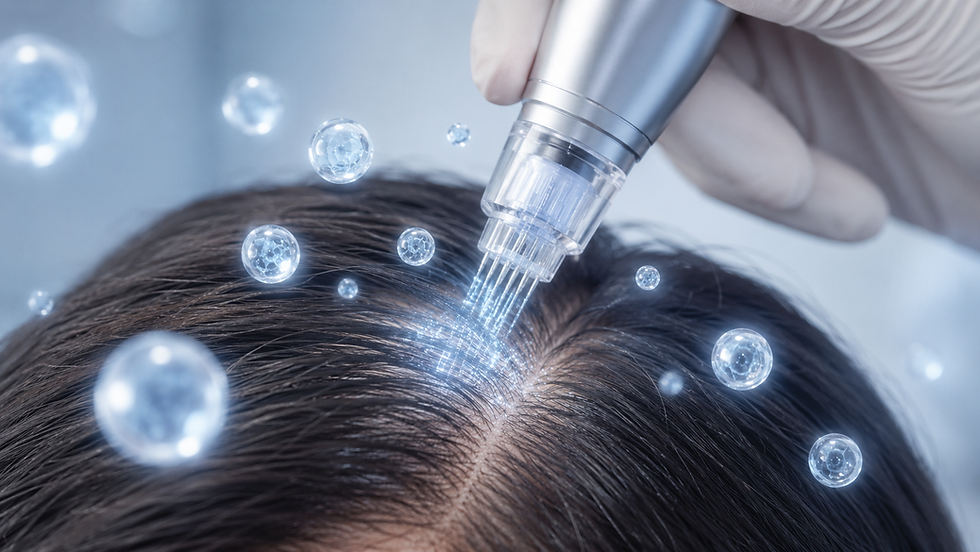
One commonly used technique is microneedling. Microneedling creates thousands of controlled microchannels within the scalp. The treatment itself also triggers a natural wound-healing response, while allowing professionally selected topical formulations to be applied directly to the treated scalp.
Interestingly, some clinical research into exosome-based hair restoration has also combined exosome formulations with microneedling.
Are Exosomes Better Than PRP?
Not necessarily.
They are different treatments.
PRP — Platelet-Rich Plasma uses a concentrated portion of your own blood containing platelets and naturally occurring growth factors.
Exosome-based treatments use externally manufactured formulations designed around cellular signalling and regenerative pathways.
PRP has been studied in hair restoration for considerably longer than exosome therapy and has a larger body of clinical evidence behind it.
Exosome technology, however, is a fascinating and rapidly developing area of regenerative hair restoration.
For some clients we may recommend one treatment. For others we may recommend a combination or alternating programme. There should never be a one-size-fits-all answer.
Can Exosomes Be Used After a Hair Transplant?

This is becoming an increasingly common question at Hair Again. Many people who have undergone hair transplantation overseas are advised to continue supporting both their transplanted follicles and existing non-transplanted hair once they return home.
Regenerative scalp treatments may form part of that ongoing programme. However, timing following a transplant matters. The scalp needs appropriate healing time, and treatment recommendations should take into account the transplant surgeon's instructions, how the scalp has healed and whether the goal is to support transplanted follicles, surrounding native hair or both.
We therefore assess post-transplant clients individually before recommending treatment.
Who May Be Suitable for Exosome Hair Treatment?
Exosome-based scalp treatments may be considered for men and women experiencing concerns such as:
Androgenetic alopeciaCommonly known as male or female pattern hair loss.
Gradual thinningWhere follicles remain present but hairs are becoming progressively finer.
Reduced hair densityParticularly when the aim is to support and strengthen existing follicles.
Age-related hair changesWhere the diameter and quality of the hair may gradually decrease.
Post-transplant hair supportWhere regenerative treatment has been recommended as part of ongoing hair maintenance.
Suitability always depends on the condition of the individual follicles.Where a follicle has permanently disappeared or been replaced by scar tissue, regenerative treatment cannot simply manufacture a completely new follicle. This is why early assessment of progressive hair loss is so important.
Why Scalp Health Matters
We often focus entirely on the hair, but healthy hair growth also depends on the environment surrounding the follicle. Excess sebum, inflammation, significant flaking, scalp conditions and poor overall scalp health may all affect that environment.
Before beginning regenerative treatment, we therefore look closely at both the hair follicles and the scalp. Sometimes improving scalp health is one of the first steps in a successful hair-restoration programme.
Exosomes Are Only One Piece of the Hair-Loss Puzzle
Hair loss can involve several factors simultaneously. At Hair Again, treatment plans may therefore incorporate different approaches depending on what we identify during your assessment.
These can include:
PRP, PRF or GFC regenerative treatments.
Exosome or advanced scalp treatments.
Regenera Activa®
Microneedling-based therapies
Topical hair-growth treatments
Prescription compounded medication where appropriate
DHT support
Hair-growth serums
Nutritional supplementation
Scalp-health treatment.
Blood-test recommendations where an underlying deficiency or health factor may be contributing.
The goal isn't simply to select the newest treatment. The goal is to work out why your hair is changing and what combination of treatments gives your follicles the best opportunity to respond.
So, Are Exosomes Worth Considering for Hair Loss?
For appropriately selected clients, we believe they can be.
The science surrounding exosome-based hair restoration is developing quickly, and early clinical studies are certainly encouraging.
However, there are still unanswered questions around optimum treatment protocols, product standardisation, frequency, dosing and long-term outcomes.
At Hair Again, we prefer to be transparent about this. Exosome treatments may offer an exciting additional tool within regenerative hair restoration — particularly when they are incorporated into a treatment plan that also considers genetics, hormones, nutrition, scalp health, medical history and the condition of the follicles themselves.
Hair Loss Is Personal. Your Treatment Should Be Too.
If you are experiencing hair thinning, increased shedding, widening of your part, recession or a gradual reduction in hair density, the first step is finding out what is happening at follicle level.
At Hair Again, our hair and scalp consultations include a detailed assessment and microscopic examination of the scalp and follicles so we can help determine which treatment options are appropriate for you.
Book a Hair & Scalp Consultation
Hair Again | Auckland Hair Loss & Hair Restoration Clinic
Information provided is general in nature and does not constitute medical advice. Results vary between individuals and treatment recommendations depend on assessment, medical history and the underlying cause of hair loss.


Comments