
Women’s Hair Loss: Causes, Early Signs and Treatment Options
This is a follow up blog to our previous one - https://www.hairagain.nz/post/effective-solutions-for-women-hair-regrowth

Why Women’s Hair Loss Can Be Difficult to Assess and Treat
Women’s hair loss is complex and is not always straightforward to identify or treat.
Unlike some forms of male pattern hair loss, which often follow a recognizable pattern, hair loss in women may be influenced by several overlapping factors. These can include genetics, hormonal changes, menopause, nutritional deficiencies, thyroid dysfunction, illness, stress, medication, rapid weight loss, autoimmune conditions, inflammation, hair breakage and styling practices.
A woman may also experience more than one form of hair loss at the same time. For example, temporary shedding may occur alongside underlying female pattern hair loss, making the overall presentation more difficult to interpret.
This means that assessing women’s hair loss requires a much more in-depth approach. It may involve reviewing:
The pattern and duration of the hair loss
Whether increased shedding is currently occurring
Changes in hair density and shaft thickness
Hormonal and menopausal changes
General health and medical history
Current medications and supplements
Nutrition, weight changes and lifestyle
Family history
Scalp symptoms or signs of inflammation
Blood-test results where appropriate
Even after a detailed assessment, there may not be one single identifiable cause or one treatment that will work for every woman. Hair growth is slow, treatment responses vary and the plan may need to be adjusted as the hair and scalp are monitored over time.
Hair Again provides a detailed trichology assessment to help identify the visible pattern and possible contributing factors. However, a trichology assessment is not a medical diagnosis. Where medical investigation or diagnosis is required, we may recommend further assessment by your GP or a dermatologist before treatment begins.
Hair loss in women is far more common than many people realise. It may begin with increased shedding, a widening part, reduced volume through the top of the scalp or the unsettling feeling that your hair simply does not look or feel the way it once did.
For some women, the change develops gradually over several years. For others, shedding begins suddenly following illness, pregnancy, menopause, stress, rapid weight loss or a change in medication.
Because women’s hair loss can have several overlapping causes, the first step is not choosing a treatment. It is understanding what may be contributing to the change.
At Hair Again Clinic in Browns Bay, Auckland, we take an assessment-first approach. We examine the scalp and hair, review the pattern of thinning and discuss your health, hormonal changes, nutrition, medications, lifestyle and family history before recommending an appropriate next step.
How Does Female Hair Loss Usually Appear?
Unlike male pattern hair loss, which commonly begins with a receding hairline or bald area at the crown, female pattern hair loss usually causes a more diffuse reduction in density.
Common signs include:
A widening centre part
Increased scalp visibility under bright lighting
Reduced density through the top or upper sides of the scalp
A smaller or thinner ponytail
Hair becoming progressively finer
Difficulty achieving the same volume when styling
Shorter, finer hairs growing through the affected area
Increased shedding when washing or brushing
More hair collecting in the shower, brush or around the home
The frontal hairline is often preserved, although the hair immediately behind it may become noticeably thinner.
What Causes Hair Loss in Women?
There is rarely one simple explanation. Some women have an inherited susceptibility to female pattern hair loss, while others experience shedding following a particular physical, hormonal or emotional event.
Several factors can also occur at the same time.
Female Pattern Hair Loss
Female pattern hair loss is a progressive condition in which follicles gradually produce finer, shorter hairs.
It may begin at any age but becomes increasingly common during and after menopause. Genetics can be inherited from either side of the family, and there does not need to be an obvious family history for it to occur.
Female pattern hair loss usually develops slowly. Many women do not notice it until their part has widened or their overall volume has significantly reduced.
Early assessment provides the best opportunity to identify follicle miniaturisation while the follicles remain active.
Menopause and Hormonal Changes
Hormonal changes during perimenopause and menopause can affect the hair-growth cycle.
As oestrogen levels change, some women notice:
Increased shedding
Finer hair
A widening part
Reduced density through the crown
Changes in texture
Slower hair growth
Greater visibility of the scalp
Menopause may reveal an underlying genetic tendency towards female pattern hair loss that was previously less noticeable.
Hair loss at this stage of life should not automatically be dismissed as simply “part of ageing.” A detailed assessment can help determine whether the pattern appears progressive and whether supportive treatment may be worthwhile.
Telogen Effluvium and Excessive Shedding
Telogen effluvium occurs when a larger-than-usual number of follicles move into the resting stage of the hair cycle. The resulting shedding commonly begins two to four months after a triggering event, which can make the original cause difficult to recognise.
Potential triggers include:
Illness or high fever
Surgery
Significant emotional stress
Rapid weight loss
Restrictive dieting
Nutritional deficiencies
Starting or stopping certain medications
Hormonal changes
Childbirth
Thyroid dysfunction
Telogen effluvium is often temporary, but recovery can take several months. It may also uncover underlying female pattern hair loss that was already developing.
Postpartum Hair Shedding
Increased hair shedding several months after childbirth is common. During pregnancy, hormonal changes can keep more hair in its active growing stage. After delivery, these hairs may move into the resting phase together, resulting in noticeable shedding.
Postpartum shedding often improves naturally. However, assessment may be helpful if it is severe, continues for an extended period or is accompanied by visible loss of density.
Prescription hair-loss medications are not automatically appropriate during pregnancy or breastfeeding and must be discussed with a doctor.
Weight Loss and GLP-1 Medication

Rapid or significant weight loss can interrupt the hair-growth cycle, whether the weight loss occurs through dietary changes, illness, bariatric surgery or medication.
GLP-1 weight-loss treatments do not necessarily damage the follicles directly. Hair shedding may instead be associated with rapid weight change, reduced calorie or protein intake, altered eating patterns or nutritional deficiencies.
Adequate protein, iron, vitamin B12, folate, zinc and vitamin D may be important depending on the individual’s circumstances.
Clients experiencing shedding during weight loss should discuss their general health, nutritional intake and medication with their own GP or prescribing clinician.
Nutritional and Medical Factors
Healthy hair growth depends on the body having access to adequate energy, protein and nutrients.
Possible contributing factors may include:
Low iron stores or ferritin
Vitamin D deficiency
Vitamin B12 or folate deficiency
Low zinc
Inadequate protein intake
Thyroid dysfunction
Chronic illness
Autoimmune conditions
Hormonal disorders
Some prescription medications
When appropriate, we may recommend discussing blood testing with your GP. Supplements should ideally be selected according to an identified need rather than taking multiple products without understanding what may be deficient.
Alopecia Areata and Inflammatory Hair Loss
Not all female hair loss is pattern thinning or temporary shedding. Smooth round patches may suggest alopecia areata, while redness, burning, tenderness, persistent itching, scaling or smooth shiny areas can be associated with inflammatory or scarring conditions.
These presentations require medical assessment. If we identify features outside our scope, we may recommend that you speak with your GP or a dermatologist before considering cosmetic or regenerative treatment.
Hair Breakage and Traction - we dont offer this service relating to hair breakage
Hair can also appear thinner because the hair shafts are breaking rather than shedding from the follicle.
Bleaching, chemical processing, heat styling, tight hairstyles and the prolonged use of some hair extensions may contribute to breakage or traction.
A scalp and hair assessment helps distinguish between reduced follicle density, active shedding and damage to the hair shaft.
How We Assess Women’s Hair Loss
At Hair Again Clinic, we begin with a detailed consultation rather than assuming that every woman requires the same treatment.
Your assessment may include:
Discussion of your hair-loss history
Review of recent health or hormonal changes
Family history
Current medication and supplements
Nutrition and lifestyle factors
Visual assessment of the scalp and hair
Trichoscope imaging
Progress photographs where appropriate
Hair Again provides a trichology assessment and does not replace diagnosis or treatment from a GP or dermatologist.
Treatment Options for Women’s Hair Loss
Treatment depends on the likely cause, the condition of the remaining follicles and whether the hair loss appears temporary or progressive.
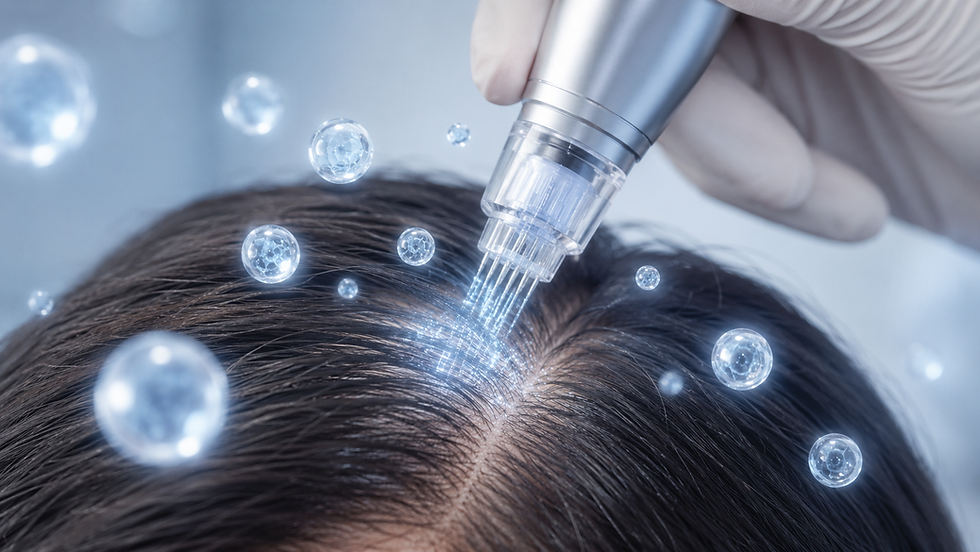
A personalised plan may include regenerative treatment, prescription support, home care, nutritional investigation or a combination of approaches. PRP, PRF and Growth Factor Concentrate. Platelet-based treatments use a concentrated portion of the client’s own blood.
Platelet-Rich Plasma
PRP is prepared by processing a small blood sample to separate the platelet-rich plasma. It is then carefully administered into areas of thinning.
Platelets contain naturally occurring growth factors involved in tissue repair and cell communication. PRP may help support active but weakened follicles and improve the environment around the follicle.
PRP is generally performed as a course rather than a single treatment.
Platelet-Rich Fibrin
PRF is processed differently and creates a natural fibrin matrix that supports a gradual release of platelets and associated growth factors.
It may be considered when shedding is significant or when a slower-release platelet treatment is preferred.
Growth Factor Concentrate
Growth Factor Concentrate, or GFC, is a refined platelet treatment that concentrates selected growth factors from the client’s own blood.
As with PRP and PRF, suitability and the number of recommended sessions depend on the individual assessment.
Regenera Activa®: A One-Off Regenerative Option
Regenera Activa is an autologous micrograft treatment, meaning that the treatment material is prepared from a small number of the client’s own healthy scalp tissue samples. The micrograft suspension is applied to areas containing active but weakened or miniaturised follicles.
Regenera Activa is usually performed as a one-off treatment, making it an appealing option for women who prefer not to begin with a monthly treatment course.
It may be considered for:
Early-to-moderate female pattern hair loss
Progressive reduction in upper-scalp density
A widening centre part
Active but miniaturised follicles
Women wanting an advanced one-off regenerative procedure
Clients who find frequent clinic appointments difficult
Regenera Activa cannot create completely new follicles where follicles have been permanently lost. Results vary, and follow-up treatment or ongoing home support may still be recommended.
Exosome and Advanced Regenerative Support
Exosome-based treatments are among the newer regenerative options being explored for hair and scalp support.
Exosomes are microscopic particles involved in communication between cells. They can carry proteins, lipids and other biological signals associated with cellular activity.
Early research is encouraging, but exosome treatment for hair loss remains an emerging area. Products, sources and protocols vary, and more high-quality research is required.
Women considering exosome treatment should understand which product is being used, how it is delivered and the limitations of the current evidence.
Compounded Medication for Women’s Hair Loss
Some women may wish to consider prescription medication alongside or instead of in-clinic treatment.
Hair Again does not independently prescribe medication. Clients complete a confidential assessment and provide the requested photographs. A Hair Again Clinical Trichologist reviews the information before deciding whether the enquiry appears appropriate to progress to our prescribing doctor.
The doctor then makes the final decision about whether medication is safe and suitable.
Finasteride and Dutasteride
Finasteride and dutasteride are not offered to women through the Hair Again compounded-medication programme. This applies to both oral and topical compounded preparations. These medications act on the conversion of testosterone to DHT and carry significant pregnancy-related precautions. They should not be used by women who are pregnant or may become pregnant.
Minoxidil
Minoxidil may be considered for some women as either a topical treatment or a low-dose oral prescription. It may help support the hair-growth cycle and improve growth from active follicles. Suitability depends on medical history, blood pressure, current medication and previous experience with minoxidil.
Oral minoxidil is prescription-only and is not suitable for everyone.
Minoxidil and Spironolactone
For some women, the prescribing doctor may consider a personalised compound containing minoxidil and spironolactone.
Spironolactone may have anti-androgen effects and is sometimes used off-label to help manage female pattern hair loss, particularly where hormonal influence is suspected. It may be combined with a carefully selected dose of minoxidil.
However, spironolactone is not automatically suitable for every woman. The doctor must consider:
Pregnancy or the possibility of pregnancy
Breastfeeding
Kidney function
Potassium levels
Blood pressure
Current medication
Heart, liver or adrenal conditions
Previous medication reactions
Spironolactone must not be used during pregnancy. Women who could become pregnant need to discuss appropriate contraception and pregnancy planning with the prescribing doctor.
The strength of any compounded medication is personalised and will be discussed after the assessment information has been reviewed.
Home Hair and Scalp Support
A treatment plan may also include:
Suitable topical scalp support
Hair-growth serums
Nutritional support where appropriate
Gentle scalp and hair care
Changes to styling or extension practices
Progress photographs
Follow-up trichoscope assessments
Hair grows slowly. Meaningful changes usually need to be assessed over several months, and ongoing treatment may be needed to maintain improvement where the underlying condition is progressive.
Which Treatment Is Right for Me?
The best treatment is not necessarily the newest or most expensive option.
The right approach depends on:
The type and duration of hair loss
Whether shedding is active
The number and condition of remaining follicles
Your medical and hormonal history
Your lifestyle
Your preference for ongoing or one-off treatment
Your budget
Whether prescription medication is appropriate
Some women may benefit from a regenerative treatment course, while others may prefer Regenera Activa as a one-off option. Medication, nutritional investigation or simple monitoring may be more appropriate in other cases.
If we do not believe a particular treatment is suitable or likely to provide worthwhile benefit, we will explain why.
Begin With a Clear Assessment
Women’s hair loss can feel deeply personal, but you do not need to work through it alone. A professional assessment can help clarify whether you are experiencing temporary shedding, progressive follicle miniaturisation, hair-shaft breakage or a pattern that requires medical investigation.
At Hair Again Clinic, our purpose is to provide honest guidance and help you understand your options without pressure or unrealistic promises.
Book a Women’s Hair and Scalp Consultation
Hair Again Clinic
761B Beach Road, Browns Bay
Auckland, New Zealand
Phone: 021 223 7522
Email: info@hairagain.nz
Important Information
This article is intended for general education and does not constitute medical advice, diagnosis or a guarantee of treatment results.
Hair Again Clinic is a specialist hair-restoration and trichology clinic and is not a medical practice. Prescription suitability and prescribing decisions are made by an independent prescribing doctor. Medical concerns may require assessment by your GP or dermatologist.
Individual suitability and results vary. Clients should consider the potential benefits, risks, limitations, alternatives and financial commitment before proceeding with treatment.
Women’s hair loss can be multifactorial and difficult to diagnose and manage. No assessment can guarantee that a single cause will be identified or that a particular treatment will produce improvement.

Comments